
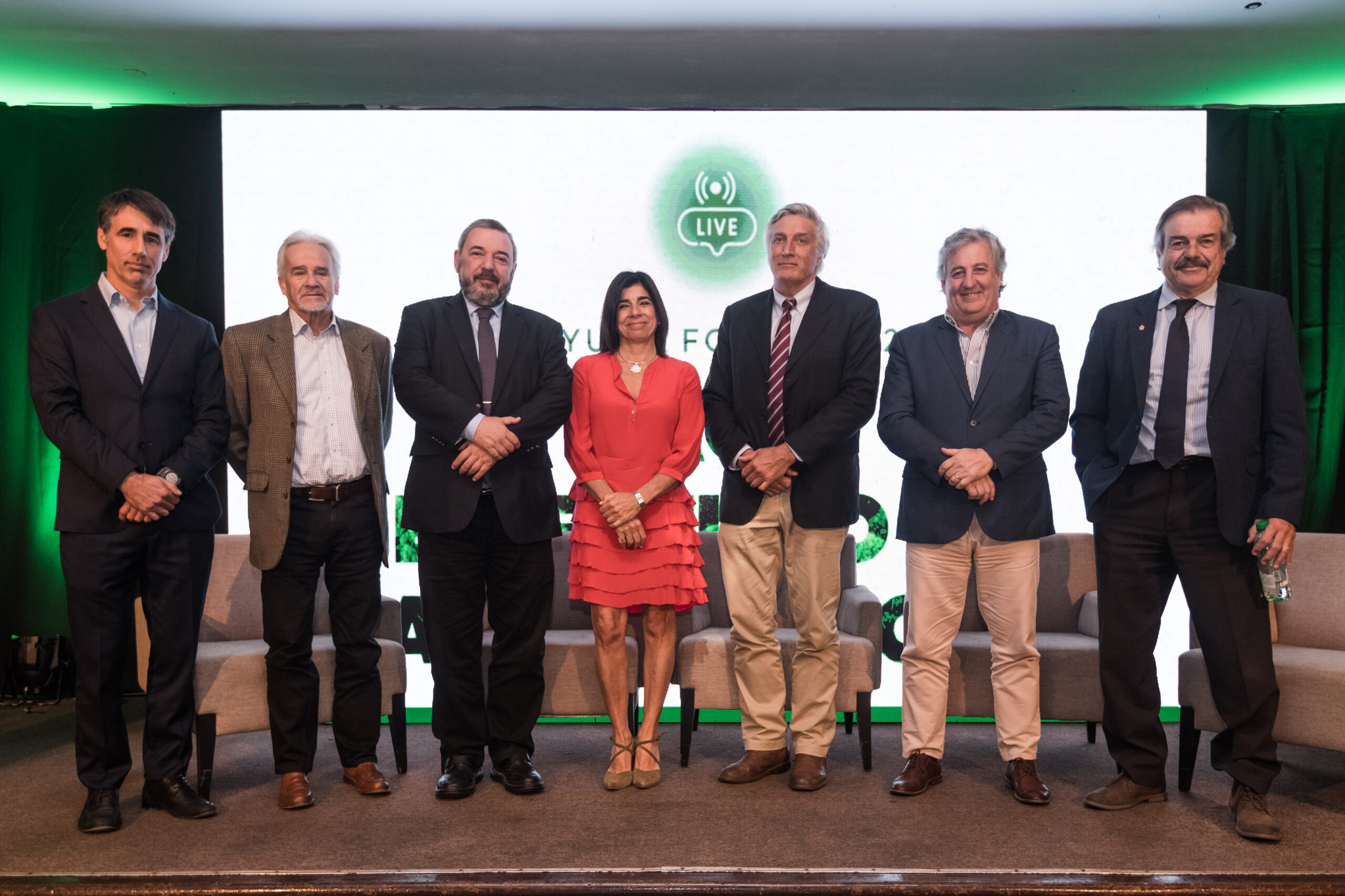
Forest Breakfast 2024
If forestry advances by 3% in Uruguay, contributions to GDP would grow by US$2.4 billion
Source: El Observador
If the forested area in Uruguay were to increase to 9% of the territory, there would be an additional contribution of US$2.4 billion to the GDP, it was highlighted at the 2024 Forestry Breakfast
If forestry in Uruguay were to advance to 9% of the territory, there would be an additional contribution of US$2.4 billion to the Gross Domestic Product (GDP); US$1.9 billion more from exports; and an extra US$110 million for public coffers, highlighted Lucía Basso, president of the Society of Forest Producers (SPF), at the Forestry Breakfast 2024.
The comment, which was framed within a sort of exercise he proposed to illustrate the impact of the sector, was made during his welcoming speech at the 6th Forestry Breakfast, held this Tuesday, September 17, at the Radisson Victoria Plaza, in Montevideo.
Basso, a forestry agronomist, mentioned these data as part of a set of additional achievements beyond the current ones that would be established with an increase in the forested area, and she did not only allude to economic benefits, as will be detailed later.
«Towards the future of forestry» He pointed out, in this regard, that to sustain what has been achieved and grow it is essential to consider three aspects: «That the rules are clear, consistent, non-discretionary and based on objective technical criteria; «streamline the times and prevent bureaucracy from becoming an obstacle»; and «continue improving our infrastructure.»
The 2024 Forestry Breakfast was titled «Towards the future of forestry» and its distinctive feature was the presence and presentation of the agricultural advisors of the political parties with parliamentary representation who will participate in the October elections: Conrado Ferber, for the National Party; Carlos María Uriarte, for the Colorado Party; Mario Bergara, for the Broad Front; Gonzalo Brum, for Open Cabildo; and Carlos Sammarco, for the Independent Party.
Also participating was economist Ignacio Munyo, executive director of the Center for Studies of Economic and Social Reality (Ceres), who updated the data from a study on the evolution of the sector, from the 1980s, when the Forestry Law was established, to the present.
Incidentally, the value of the Forestry Law and the relevance of the State policy sustained during the eight consecutive governments since the resumption of democracy in Uruguay were aspects praised by Basso, who stated that the forestry sector «is positioning itself as the main exporter of goods in Uruguay», with a firm course towards US$ 3 billion a year.
«More than 30,000 people and 1,800 SMEs across the territory work professionally, with commitment and with true passion for what they do,» he emphasized.
Leading sector in exports After Basso’s presentation, economist Munyo, in the conclusions of the updated Ceres study on the forestry sector, stated that it is already the main export sector of goods.
They brought in US$2.761 billion in the last 12 months, up to August 2024, 22.2% of the total and ahead of beef and meat by-products – with US$2.542 billion and 20.5% of the total – he reported.
He added that there are, in that sense, additional opportunities for expansion, especially in the solid wood segment, with a high impact on the economy.
Regarding sustainability, the CEO of Ceres said that there are advantages to coexisting with livestock farming, multiple examples of circular economy, and international regulations and certifications that ensure sustainable practices.
Regarding tax contributions, he noted that currently, throughout the entire production chain, forestry for the production of cellulose and sawmills, together with dairy farming, are the sectors that pay the most taxes in relation to the hectares allocated to production.
Finally, when considering the challenges, he stated that there are challenges due to automation, which requires continuous training and specialization of human capital, as well as the incorporation of technology and problems of competitiveness and port tariffs.
One fact highlighted by Munyo, who even mentioned that the plaque was ideal to leave visible throughout the day, was the sector’s participation in GDP, which in Uruguay was barely perceptible -0.2%- in 1994 and far from the then 4.5% of a benchmark like Sweden, data that today are at 3.5% for Uruguay and 3.1% for Sweden, while Argentina, for example, remains at 0.1% despite the passage of some 30 years.
This, he emphasized, was made possible by long-term public policies and tax incentives at the outset; institutional stability over time; security and confidence to attract investment; and the participation, precisely, of recognized international investors.
Basso: a «totally positive» assessment. When asked by El Observador about the activity carried out, Basso expressed that «the assessment is totally positive, it was an objective achieved for us.»
He explained that the SPF was «very» interested in having representatives from all political parties attend «and so it was, it was difficult but it was achieved.»
The importance was based on «providing them with first-hand, up-to-date information on all issues in the sector and allowing them to express their views and proposals.»
«All of that was fulfilled and fulfilled well. We saw that in general they were very well prepared and they provided us with input that, for us as a sector, as a society, as a trade association, is very useful,» he stated.
She noted that there were comments related to the three points she cited in her speech – clear rules, bureaucratic delays, and infrastructure – that either reaffirmed what the SPF maintains or provided constructive elements to be considered «when continuing to work on and improve these crucial challenges that, as we mentioned, lie ahead.»
On the other hand, regarding Munyo’s presentation, the president of the SPF commented that «as he himself said, this work was based on real data, not on estimates as on the previous occasion, and from the first graph he was very illustrative, he really showed where the sector stands, why it is the leading sector of the economy, what its growth has been based on, its prospects, for example he clearly illustrated the issue of the tax burden which, as you know, is something that is always being blamed on us and with this work the truth was shown, with the numbers from the DGI, so that’s how it is.»
In short, Basso concluded, «the outcome of this Forestry Breakfast is very positive; we obtained very good input and at the same time made a good contribution to the political system in preparation for the next government. Very good information was provided to the agricultural advisors of the presidential candidates, and we are very happy and very grateful for the support we received.»

